
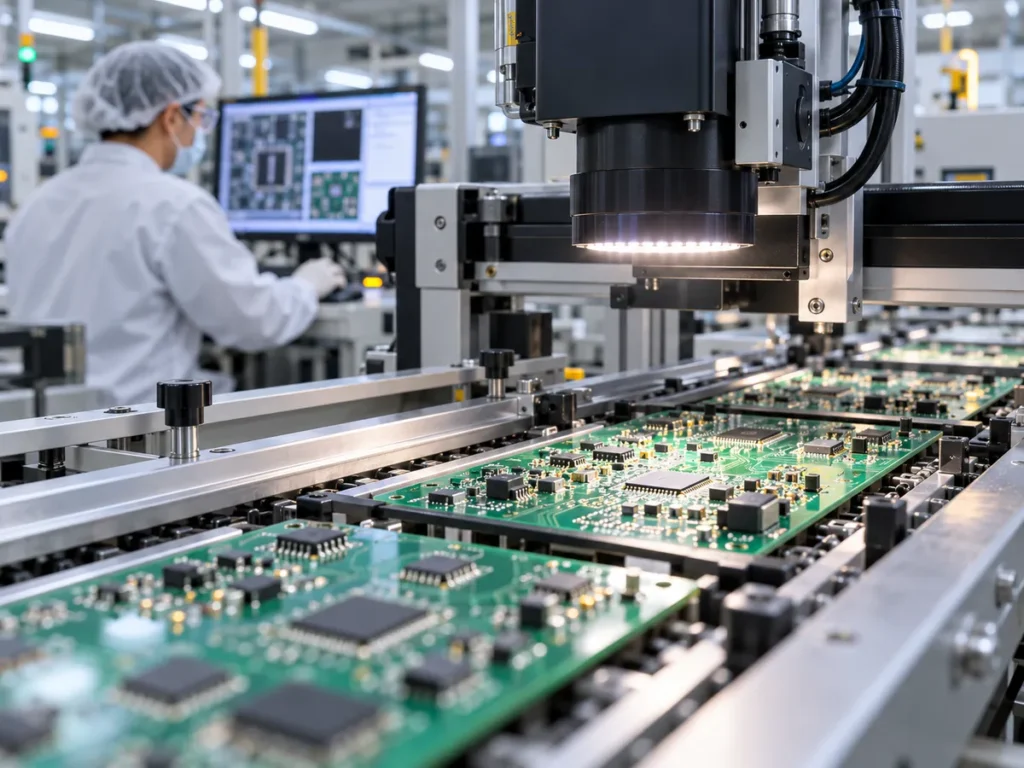
Circuit boards on an electronics line move quickly. A single overlooked flaw might result in thousands of returned units.
A single machine breakdown can bring an entire SMT line to a halt for hours. Nobody notices until output decreases and the shift report appears incorrect.
After working long shifts, inspectors become tired. Weary eyes miss hairline cracks and chilly solder joints that a camera would quickly capture.
Unexpected supply delays also occur. A missing capacitor can stop a whole production run, even when everything else on the line is ready.
Planners are still juggling spreadsheets to reschedule tasks. A single incorrect guess wastes an entire day's worth of capacity, and the line never recovers it.
All of this is not rare. On actual production floors, these issues arise every week, and each one gradually reduces profit. The entire cost of a single problem is rarely seen by a plant manager since it is often absorbed into overtime, scrap, or a rushed apology to a customer. But when you add them up over a quarter, the number becomes difficult to ignore.
That is why more electronics manufacturers are now asking how to implement AI in electronics manufacturing, rather than whether it is worth doing at all.
This guide discusses how to develop a pilot who scales without interfering with an existing line, where AI fits on the floor, and which use cases pay off initially.
Where AI Fits on the Electronics Factory Floor
AI is not a single system in the production of electronics. It is a collection of tools that work with the computers and information you already own.
Machine vision cameras monitor the boards as they move down the line. Condition data is continuously streamed via sensors on reflow ovens and pick-and-place equipment. Orders, routings, and deadlines are already stored in planning software.
AI considers all of that information before making a decision. A flaw is identified before a person would notice it. Meanwhile, a machine gets a warning that it is drifting out of tolerance. A better manufacturing sequence is proposed somewhere else on the floor before a delay ever occurs.
This is significant since the production of electronics depends on tight tolerances and strict standards. A tiny error rate quickly adds up to thousands of units produced daily on a PCB assembly line. Machine learning and computer vision are ideal for this type of high-volume, repetitive judgment decision because the pattern rarely varies, regardless of the board design.
Some plants are now using agentic AI, in which a system takes a constrained action on its own, such as pausing a feed or rerouting work to another line, rather than simply flagging a problem. Although it still requires clear guidelines, that type of automation demonstrates the future direction of technology.
The goal is not to replace operators. It is to provide them with more information sooner so that the line may self-correct before a little error becomes a discarded batch. When it comes to matters pertaining to customer commitment or product safety, staff still have the last say.
The Use Cases That Pay Off First
Not all AI use cases are appropriate during the first year. While some are worth the price right once, others require longer data history. Here are the manufacturing AI use cases that electronics plants typically start with, listed in the order in which they tend to pay for themselves.
Optical Inspection and Defect Detection
Automated optical inspection has been available for a while, although rule-based systems produce too many false alarms. AI-based machine vision distinguishes between a genuine flaw and a harmless shadow or a tiny color shift by learning from labeled photos rather than strict restrictions.
This entails detecting solder bridges, tombstoning, and missing components at line speed for SMT and assembly lines. As the model sees more boards, defect identification becomes better, which is uncommon for a high-quality tool. The longer a system is in operation, the better it becomes.
Inspection becomes more consistent between shifts. The defect standard remains constant from the morning run to the night run since a camera does not grow weary at hour seven like a human does. When a plant manager is considering a first pilot, that consistency alone is frequently the most straightforward commercial argument.
Predictive Maintenance
Wave soldering equipment, pick-and-place heads, and reflow ovens all wear down in predictable ways. Data on cycle count, temperature, and vibration can identify wear before a breakdown occurs.
According to McKinsey's factory analytics research, predictive maintenance usually increases machine life by 20 to 40 percent and decreases downtime by 30 to 50 percent. That kind of reduction alters the output of the entire shift on an electronics line, where an unscheduled stop can idle dozens of downstream stations.
It is not necessary for a predictive model to be flawless in order to be effective. Maintenance staff can schedule a repair during a scheduled changeover rather than in the middle of a live production run with even a rough early warning. That temporal discrepancy alone frequently justifies the pilot.
Yield and Quality Optimization
Yield optimization shifts the focus of quality control from individual flaws to the process settings that underlie them. AI is able to correlate the yield outcome for each batch with oven temperature curves, solder paste volume, and placement precision.
Over time, the algorithm suggests minor process changes that a human engineer would never test manually due to the sheer number of variables involved. Over the course of a production run, little, consistent yield gains add up.
This use case typically pays off second, immediately following inspection, because it relies on having enough clean process data coming from the line. Defect detection-focused plants typically create that data trail with little additional work.
Production Planning and Rescheduling
Electronics manufacturing facilities are often juggling rush orders, short lead times, and component shortages. When a machine malfunctions or a part comes late, AI-assisted production planning can reorder operations in a matter of minutes rather than requiring a planner to manually rework a spreadsheet.
This use case works well with a digital twin of the line because planners may virtually test a change to the schedule before committing the floor to it. A digital twin also allows novice planners to learn the restrictions of a line without having to go through the trial-and-error process.
BOM Validation and Supplier Signals
When a line finds an obsolete or substituted part, a bill of materials, or BOM, error might stop a construction. AI tools can cross-check a BOM against supplier lead times, component lifecycle status, and prior substitution history before a job ever reaches the floor.
This improves supply chain visibility as well. Planners receive an early warning so they have time to find a substitute, rather than responding to a shortage on the day it occurs.
Electronics parts also change quickly, with components becoming obsolete or being replaced by a newer part number each year. A BOM validation tool that tracks lifecycle status detects that risk well before a build date, rather than the morning when a line realizes the part is missing.
A Step-by-Step Path to Implementation
A successful rollout follows a sequence. Skipping a step usually shows up later as a stalled pilot or a system nobody trusts.
Identify Decision-Heavy Workflows
Start with use case discovery, not technology selection. Look around the floor and identify the choices that now require the highest amount of human judgment, such as scheduling adjustments, inspection calls, or maintenance scheduling.
These are the workflows where an AI application produces a quick, visible outcome because these models are specifically designed to facilitate machine judgment calls. Talk to the operators doing the task, not simply the managers evaluating the reports, because operators typically know which decisions generate the greatest rework.
Ready Your Data and Systems
Most teams underestimate the importance of data readiness. AI requires reliable, labeled data from cameras, sensors, and your MES or ERP system to learn anything valuable.
Connect the five separate systems that contain machine data initially. It is worse than having no model at all when a model trained on incomplete or chaotic data makes confident but incorrect decisions.
IoT sensors can fill the gaps in outdated equipment that manufacturers did not design with data output in mind. A retrofit sensor kit is frequently less expensive than replacing a machine in addition to putting a historical line into the same data flow as more recent equipment on the same floor.
Pilot on One Line
Choose a single product family, a single shift, or a single line for the pilot. Comparing before-and-after outcomes and identifying issues early are much simpler with a limited scope.
Run the pilot for a longer period of time than just a calm week to observe actual fluctuation in demand and defect types. For most electronics use cases, four to eight weeks is a reasonable starting point.
Establish a clear pass or fail line before the pilot begins, rather than after the results are in. Early agreement on that criteria prevents a mediocre outcome from being reframed as a success and maintains the review's integrity.
Integrate, Validate, and Scale
Connect the AI system to your MES, ERP, or quality database so that it automatically writes results back if the pilot proves successful. Manual re-entry undermines the goal of automation.
Before scaling further, verify accuracy against a human baseline. Expand line by line after that, as a model optimized for one product mix will need retraining before it can be used for another.
Include a brief retraining timetable in the rollout strategy right away. A planned check prevents performance from silently declining because a model that performed well in the first month may drift if suppliers, product mix, or seasonal demand change.
What Makes Electronics Manufacturing Different
The manufacturing of electronics differs from heavy industries such as industrial equipment or automobiles. First, there are fewer tolerances. Defects can be as small as a millimeter, which forces AI vision systems to interpret information more quickly and with higher resolution than what an assembly line typically requires.
Second, the product mix is constantly changing. Electronics contract manufacturers routinely swap between product lines within the same week. A model designed for automotive, where the same part runs for months, will not adjust well to that pace without retraining support built in from the beginning.
Third, there is a lot of risk at the component level. A single incorrectly labeled component on a crowded board can cause a field failure long after the device has shipped. Compared to industries where parts are larger and easier to verify visually by hand, this makes BOM validation and traceability more challenging.
Lastly, cycle times are brief. Any AI system in the inspection loop must keep up with the line rather than slow it down because many electronics manufacturing procedures take seconds rather than minutes.
These distinctions help to explain why a generic industrial AI platform designed for a slower or heavier industry frequently requires significant customization before it can be used on an electronics floor. A vendor's track record in PCB and SMT environments specifically is worth checking before signing a contract.
Measuring ROI on the Floor
A manufacturing AI project's return on investment (ROI) is derived from several distinct sources, including improved yield, reduced unplanned downtime, fewer defects reaching customers, and fewer scheduling delays. Each of these should be measured against a baseline captured before the pilot starts.
Avoid the temptation to promise a single ROI figure before the pilot runs. Every line has a different beginning point, and a number taken from a vendor's slide presentation rarely corresponds to conditions on your floor.
According to Deloitte's Smart Manufacturing and Operations Survey, 80% of manufacturers want to devote at least a quarter of their improvement budgets on smart manufacturing projects like these. This amount of spending indicates that ROI on the floor is becoming more of a regular budget line rather than a one-time trial.
You should regularly monitor a few metrics, including defect escape rate, mean time between failures, first-pass yield, and on-time completion rate. A change worth scaling should appear in the figures early, so if a metric does not change inside the pilot window, review the use case before expanding it.
Review these numbers on a fixed weekly cadence rather than waiting for a formal end-of-quarter report. Long before it manifests as a more serious quality issue, a weekly check can identify a drifting model or a data stream that has silently failed.
Manufacturers of electronics in Australia are already heading in this way. According to data from the National AI Center, 43 percent of Australian small and medium businesses reported some level of AI adoption between December 2025 and February 2026, and Austrade's Australian AI Industry Capability Report, prepared in collaboration with CSIRO, found that more than half of organizations across the country are now using AI in some form. Electronics plants that weigh a pilot are not getting ahead of the competition. They are coming up to the position that an increasing portion of Australian industry now occupies.
Conclusion
The best results from AI deployment in electronics production come from starting small and staying close to a genuine, quantifiable problem. Production planning, predictive maintenance, and defect detection are all good places to start since they provide a clear before-and-after image.
Vendors and platforms will continue to evolve. What stays constant is the discipline: find the decision-heavy workflow, get the data ready, pilot on one line, and only scale once the numbers hold up. Teams who adhere to that sequence typically steer clear of the stalled projects that damage AI's reputation in manufacturing.
The most frequent error is rushing to a plant-wide rollout, which is also the simplest to prevent. Because the data are clear enough to be trusted, a single, well-measured line can tell you more in six weeks than a large deployment can in six months.
Intelinova can assist in outlining the workflow, the data readiness gap, and a practical pilot strategy for your floor if your team is planning a first pilot or determining which use case to begin with.
What are the best AI use cases for electronics factories?
Optical inspection and flaw detection typically produce the fastest results, as machine vision detects solder and positioning problems that fatigued human inspectors overlook. Predictive maintenance comes next, safeguarding pick-and-place machines and reflow ovens' output. Production planning and BOM validation provide a solid foundation, especially for facilities that manage frequent product changes and component shortages on a tight timeline.
What data do you need for factory AI?
You require reliable, labeled data from the existing systems that run your line: camera images for vision models, sensor readings for predictive maintenance, and order or routing data from your MES or ERP. Model selection is less important than data readiness. A pilot can start operating weeks sooner with a modest, tidy dataset from a single line rather than a huge, disorganized dataset gathered from five separate systems.
Should you build, buy, or partner?
Most electronics firms collaborate or purchase rather than construct from scratch, as vendor platforms already handle machine vision and predictive models that would take years to develop in-house. Only when a use case is really specialized to your process and no vendor tool is suitable does building make sense. The quickest way to determine fit before allocating funds is typically through a pilot project with a partner.
How long does a manufacturing AI pilot take?
The majority of electronics pilots focus on a single line or product family for four to eight weeks. This span is long enough to capture actual changes in demand and defect types, not just a quiet week that looks better than regular operations. If early findings are uneven, extend the pilot, as scaling a model that hasn't proven stable usually leads to more rework later.
How is ROI calculated on the floor?
Compare the defect escape rate, unscheduled downtime, first-pass yield, and on-time completion to a baseline recorded before the pilot's start. Compare these numbers weekly rather than waiting for a single end-of-pilot report. Prior to a broader rollout, it is worthwhile to review the scope if a use case does not improve at least one of these indicators during the pilot period.