
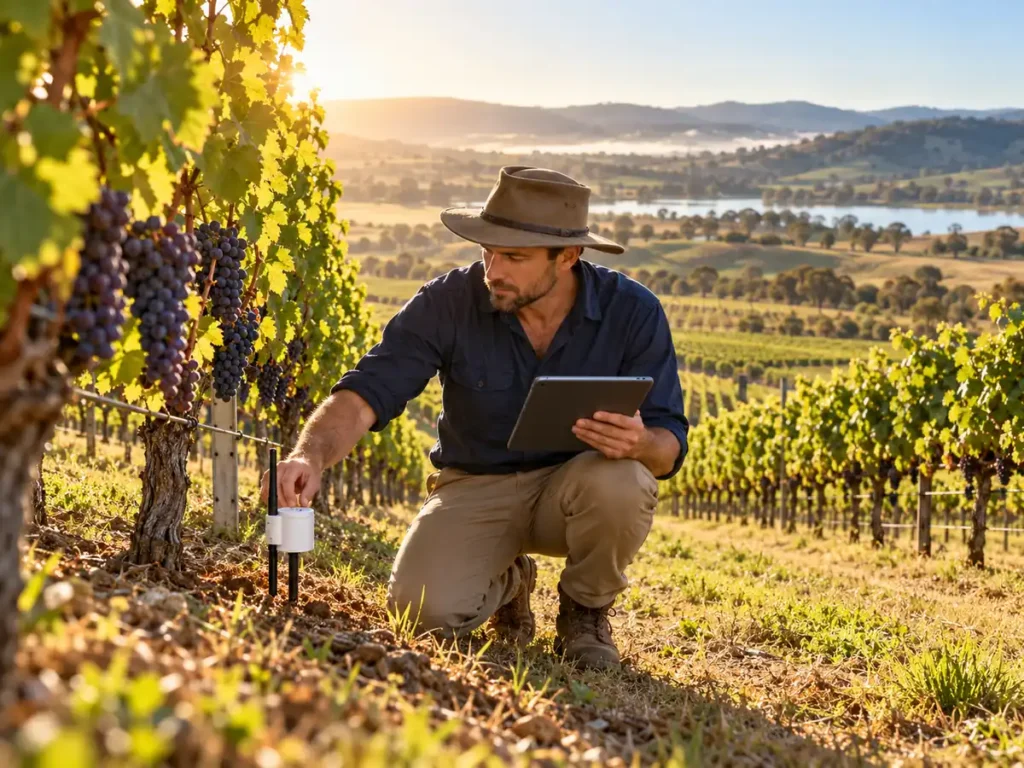
Grapes don't wait for an empty spot in the roster. Wineries need workers in the cellar, on the crush pad, and on the vineyard when vintage strikes, frequently in a matter of days. Harvest might become a scramble due to a dearth of seasonal workers. Also, a single missed selecting window might erase months of meticulous work.
There is additional pressure due to the weather. Sugar levels can change overnight due to a single heatwave. Growers that depend solely on visual inspections are therefore frequently responding rather than preparing. In the meantime, there is little opportunity for speculation as margins continue to decrease and grape prices fluctuate from year to year.
The majority of wineries still rely on spreadsheets, instinct, and years of hard experience. That experience is important, but it doesn't apply to 10 blocks, three different types, and a labor pool that is getting less. Growers are increasingly posing the straightforward question: can technology quickly fill the gaps left by humans alone?
This is the point at which the Australian wine business adopts AI. Wineries are using sensors, satellite data, and prediction models to make better, faster judgments. The shift is still in its early stages, but it is genuine and impacting the way growers plan their seasons.
Where AI Adoption in the Australian Wine Industry Stands Today
Australian AI adoption is accelerating, and wine is part of that shift. The Australian Bureau of Statistics estimates that 12% of Australian companies use AI at work. In short, that is a twelvefold increase in three years, demonstrating how quickly the technology has progressed from specialty to mainstream.
Wine has not been left behind. Predictive forecasting, satellite monitoring, and precision viticulture methods are increasingly often discussed at industry conferences and events. Adoption still varies based on the size of the winery, though. Larger growers with dedicated agronomy teams are more likely to move first, whereas family-run vineyards may wait until a tool has shown itself on a neighboring block.
Wine Australia's research program has supported various initiatives investigating how grapegrowers and winemakers adopt new technology, and the trend remains consistent. Growers don't trust promises on a slide deck but results they can observe. The most effective technologies tend to handle a single specific problem, such as estimating yield or detecting disease early, rather than revamping the entire business at once.
Australian wine is not driving the national trend but rather following it. That's not a criticism. It only represents a sector in which trust is gradually gained, one successful harvest at a time.
What Is Pushing Wineries Toward AI
A few pressures are converging at once, and together they explain why interest in AI has grown so quickly. First, according to Wine Australia's National Vintage Report, the wine grape crush was worth $1.13 billion, a 14% increase over the previous year. Even so, total tonnes stayed well below the 10-year average. In other words, growers are being challenged to generate more value with a limited supply. That kind of pressure encourages quicker judgments.
Second, there is a shortage of manpower. According to Wine Australia, the Jobs and Skills Australia Recruitment Experiences and Outlook Survey revealed that 56% of hiring companies in the industry reported having trouble filling positions. Wineries are being forced to rely on instruments that can accomplish more with fewer personnel because seasonal positions are particularly difficult to fill.
Third, the stakes continue to rise due to climate variability. According to climate researchers writing for The Conversation, wine regions throughout Australia are expected to warm by about 3°C by the year 2100. So, with each passing year, the margin for error in terms of picking dates, irrigation, and canopy management shrinks. As a result, decisions that were previously based solely on experience now benefit from daily data updates rather than once a season.
These three factors work together to explain why AI is evolving from a curiosity to a useful tool in the wine industry. Wineries are not pursuing AI for its own sake. In fact, they are seeking certainty in an industry that has never had much of it.
AI Across the Wine Value Chain
AI now touches almost every stage of winemaking, from the first bud burst to the bottle on a shelf. Below is a walk through where it's making the most difference, stage by stage.
Vineyard and Viticulture Management
Block by block, precision viticulture monitors moisture, canopy health, and vine stress using sensors, soil probes, and satellite imaging. Growers may identify trouble spots on a screen and dispatch a team directly to those areas rather than manually traversing every row. All things considered, this alone saves actual time during the busiest weeks of the year.
Scheduling irrigation is another area where machine learning models are useful. For example, by combining weather forecasts and soil data, these systems may recommend how much water each block requires rather than imposing a blanket plan to the entire property. As a result, growers use less water while maintaining fruit quality, which is more important every season as water gets scarcer.
Harvest and Yield Prediction
One of the most obvious benefits of AI in winemaking is yield prediction. Models that predict tons per block long before harvest starts are fed historical yield maps, current weather, and vine health data. That early picture helps with manpower, tank space, and contract preparation, all of which are difficult to organize on short notice.
Computer vision is playing a growing role too. For example, cameras installed on tractors or drones provide growers with a helpful check against manual sampling by counting bunches and estimating berry size. This kind of early warning is crucial to the outcome of a vintage because harvest windows are limited and weather can change rapidly.
Winemaking and Fermentation Control
Sensors in the winery monitor temperature, sugar, and acidity continuously during fermentation. AI systems alert winemakers when a ferment begins to deviate from its intended profile, allowing them to make necessary adjustments before a quality control problem arises later.
Predictive tools for blending are also being tested by some producers. However, most winemakers handle the final decision as a human one, and these models simply recommend pairings based on chemical analysis and historical results. This place still values tradition, and in all honesty, it probably always will.
Marketing and Consumer Insight
Wineries can determine which varieties and price points will sell in a particular market with the aid of demand forecasting tools. These tools use both more general trend data and sales history. This is especially important for export-oriented manufacturers who must manage fluctuating demand in Asia, the US, and the UK, where consumer tastes might vary seasonally.
AI also enables more customized marketing, from tasting room recommendations to email advertising based on a customer's previous purchases. Smaller wineries can use these tools without the need to hire a full marketing team, leveling the playing field against larger competitors with bigger expenditures.
Supply Chain and Logistics
There are several moving components in wine supply chains, including export paperwork, customs paperwork, and bottling timetables. AI-powered planning tools aid with demand forecasting, inventory management across warehouses, and early detection of potential delivery delays before they become a major issue.
This kind of visibility might therefore mean the difference between reaching a shipping window and completely losing a market for exporters. Given how competitive worldwide wine sales have gotten in recent years, timing is increasingly important.
Sustainability and Climate Resilience
Sustainability is no longer a side project for most wineries. AI also helps in this area, from maximizing water utilization to lowering energy usage in processing and refrigeration lines. In order to plan replanting tactics around anticipated long-term climate shifts in their area, some farmers now employ predictive models.
This kind of forward planning is no longer optional because Australia's wine regions face significant problems related to climate resiliency. Instead, it's starting to contribute to a vineyard's viability for the upcoming generation of growers.
What the Adoption Data Shows
Australian wine is part of a larger agricultural industry where digital tools are still relatively new. According to national data, the percentage of Australian enterprises using AI increased from 1% to 12%. Although it typically lags behind industries like finance and professional services, agriculture is following a similar trajectory.
Adoption in wine in particular tends to concentrate around a few use cases: quality monitoring, yield prediction, and irrigation. In most vineyards, these applications are the first through the door because they provide the most obvious and quantifiable payoff.
In the meantime, larger businesses are outpacing tiny, family-run vineyards in terms of speed. Larger producers have more information, resources, and space to experiment without having to risk the entire season on a single trial project, so this is not shocking. Still, the gap is starting to close as tools become cheaper, simpler, and easier to deploy without a specialist team.
The data generally presents an almost consistent picture. Enthusiasm is not the only factor in adoption; resources and risk tolerance are also important. More of the industry is probably going to follow as tools get more sophisticated and reasonably priced.
What Is Holding Wineries Back
Not every winery is ready to adopt AI, and the reasons are usually practical rather than philosophical. Three barriers come up again and again.
Cost and Infrastructure
Sensors, connectivity, and software licenses are obviously expensive, and isolated vineyards may not always have dependable internet to support them. Even when the long-term justification is compelling and the payback period is brief, a small operation may find it difficult to justify the upfront expenditure.
Skills and Data Maturity
Many vineyards lack reliable historical data for model calibration or training. Even a good AI program finds it difficult to produce reliable results without such a base. In addition, employees must have a practical grasp of the meaning of the outputs, which requires training time that few wineries can afford during vintage.
Tradition and Trust
Winemaking carries generations of craft knowledge, and that's not something growers want replaced by an algorithm overnight. Trust builds slowly in this industry, as it should. Typically, a tool has to prove itself on real fruit, over more than one vintage, before most winemakers will lean on it with confidence.
Getting Started in a Small Winery
Adopting everything at once is not necessary for a small winery, and doing so would likely backfire. The wineries that succeed with AI usually start narrow and build from there.
Choose one issue that has to be resolved first. Yield prediction and irrigation scheduling are popular places to start because the results may be seen in a single season and the data needs are reasonable.
Next, see what information is already available. A pilot can be started with weather records, historical yield data, and even basic spreadsheets. A winery only needs a workable dataset at first, not a flawless one.
Then, before expanding anything further, conduct a brief trial on one or two blocks. This keeps risk low. It also allows employees to gain confidence in what the tool is telling them, rather than blindly accepting it from the start.
Lastly, include those who will be using the product on a daily basis. No matter how accurate a system is on paper, it won't be implemented if the vineyard manager doesn't believe it. Therefore, buy-in is just as important as the technology itself.
How Intelinova Helps
Intelinova works with Australian wine companies in order to scope AI pilots that fit the size and budget of the business. It's not an enterprise deployment designed for another company. Practical successes that a small team can handle without adding more experts, such as yield prediction or irrigation planning, continue to be the main focus.
The statistics and objectives of each vineyard are unique. Intelinova begins with a brief exploration process to see where AI may actually help instead of promoting a predetermined package regardless of fit. The team then assists in connecting current data sources, setting up the appropriate tools, and training employees to use the outcomes with genuine confidence.
Headline: Ready to explore AI adoption for your winery?
Subheadline: Get a practical plan for AI adoption that fits a small operation, not a generic enterprise rollout. Implement one clear use case, connect your existing data, and start seeing measurable results within a single season.
Final Thoughts
The introduction of AI in the Australian wine industry is not intended to take the place of the craft that defines wine. Rather, it's about providing growers and winemakers with more accurate information when it matters most. Choosing when to select, whether to irrigate, and how to prepare for a hotter decade ahead are all part of this.
Adoption is still in its early stages. Wine sits in the middle of that wider curve, with many wineries remaining on the sidelines and pockets of quick movers. Considering how much trust this sector requires before making changes to its operations, that's a reasonable place to be.
The way forward doesn't have to be dramatic for a small winery. Start with a single problem, make advantage of the available data, and progressively establish trust, one vintage at a time. That is how long-term transformation occurs in an industry based on patience, skill, and a healthy regard for the land.
How is AI used in the Australian wine industry?
AI helps with a number of winemaking processes, such as demand forecasting, fermentation monitoring, yield prediction, and irrigation scheduling. Meanwhile, vineyards utilize sensors and satellite data to assess vine health on a block-by-block basis, while wineries use predictive algorithms to regulate fermentation and forecast market demand. The majority of producers begin with a single, obvious use case and then grow once the outcomes are evident instead of implementing AI throughout the entire business at once.
Can AI predict grape harvest and yield?
Yes, AI models use historical production data, weather trends, and vine health information to predict tons per block well in advance of harvest. In a vineyard, computer vision equipment installed on tractors or drones may also count bunches and gauge berry size. This minimizes last-minute rushing by providing producers with an early picture for manpower, tank space, and contract preparation well before picking even starts.
Does AI improve wine quality?
AI can assist growers in reducing vine stress before it damages the fruit and identifying fermentation issues early on. Real-time temperature, sugar, and acidity sensors allow winemakers to make necessary adjustments before issues arise. However, since taste and craft are still hard for any model to entirely duplicate, the winemaker's judgment remains the final arbiter of winemaking decisions, including blending.
What holds back AI adoption in wineries?
The main obstacles are cost, connectivity, and data maturity. Reliable internet is not always available in rural vineyards, and many small growers are reluctant to make the initial investment required to set up sensors or software. Many wineries also lack clean historical data needed to train models effectively. Also, trust develops gradually in a field based on generations of practical craft expertise and hard-won intuition.
Is AI adoption growing in Australian wine?
Yes, and it reflects a larger national trend in the majority of industries. The Australian Bureau of Statistics reports that the percentage of Australian enterprises using AI increased from 1% to approximately 12%. Wine is going in a similar direction. This is most evident in the areas of irrigation, production forecasting, and quality monitoring, where the benefits are most obvious and simple to explain to a cautious grower.
How can a small winery start with AI?
Start with one specific problem, like irrigation or yield prediction, rather than trying to overhaul everything at once. Check to see what data is currently available, as a modest, usable dataset is typically sufficient to get a pilot up and going. Test the tool on one or two blocks first and involve the workers who will use it every day to ensure that the results are genuinely trusted, adopted, and utilized long after the trial is over.